Thursday, June 18, 2009

Lightning Makes A Striking Pose - My Vision

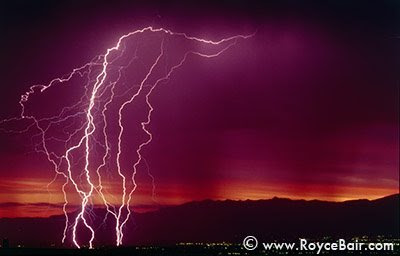
(Click on image for a larger view, or click here to see a series of four images on my Flickr photostream.)

I think lightning photographs continue to amaze people because of their awesome force, and because they are a very graphic icon of nature's power that is often used to represent power in modern technologies. And because of this relationship, I've made many stock photo sales from my lightning images.

Photographing lightning is relatively simple: the camera's shutter is manually opened until one of more lightning strikes occur within the camera's field of vision. The lightning itself acts as an electronic flash -- exposing itself or freezing the image onto the digital sensor or film. (An manual exposure setting of f8 for an ISO of 100 will work as a starting point under most conditions.)

The real trick is guessing where best to aim the camera, and how long to leave the shutter open. Pointing the camera where recent lightning strikes have occurred is the best wisdom, with adjustments based on the storm's speed and direction. Some photographers will shoot "wide" and crop in using Photoshop. (All of my lightning photos are uncropped.)

Time exposures can be often produce surprises (good and bad). The longer you leave the shutter open, the more lightning strikes appear in the image, usually making for a more dramatic image. And the movement of the clouds during a long exposure can produce some dreamy effects. However, leaving the shutter open too long can also wash out the details of clouds and surrounding landscape, especially if there are bright city lights or leftover twilight from a sunset (or impending dawn).

If all this seems too technical, don't worry, most point-and-shoot cameras will automatically set the aperture or "f-stop" and close the shutter when enough light has reached the camera's image sensor (just keep in mind that most P&S cameras cannot time expose longer than 30 seconds, so some of your options are limited). Consult your manual for time-exposure menu settings. (It should go without saying that all this requires a steady tripod.) For more technical information and tips on lightning photography, refer to this Matthew Cole page, this LightningBoy page, or Guy Tal's Mountain Trail Photo Blog.

You can also view my Flickr Photostream to see more of "My Vision."

Tuesday, June 16, 2009

Moonlight Reflecting Across the Ocean - My Vision

"Moonlight" across the ocean ~ © Royce Bair (Click image for a larger view)
This photograph was from the deck of a cruise ship, while cruising the Mexican Riviera in early December. I was teaching a photography workshop on this trip, and I took this shot in between classes. The idea in my mind was to create a romantic, moonlight evening view of the ocean, as one would see from the elevated deck of a cruise ship.

This shot is only an illusion to the nighttime. The image was taken in the daytime, with the sun just outside the camera view, so I had to shade the lens with my other hand. Photographing the reflection of real moonlight across the ocean would have required a time exposure that would have blurred the ocean waves to almost complete smoothness -- not to mention the fuzzy horizon line due to the ship's motion. This illusion is similar to how movie makers do "night" scenes -- underexposing the scene and using a blue filter, or changing the color balance in post-production. Note: in the early B/W days, a red filter was used, not to change color, but to increase contrast in the B/W image.

The original photograph was mainly shades of gray, with very little color. Post-production of the raw image in Photoshop changed the scene into millions of shades of blue. The sky also had to be darkened considerably. The final touch was to give the image a slight pinch-cushion distortion to increase the curvature of the ocean horizon. This less than 3% curvature has an amazing effect on the mind. The image becomes less static, more recognizable, more memorable, and more exciting.

I photographed some stunning locations on this trip, but this simple, conceptional icon has made more stock photo sales that any of the other images I took.

September 2012 update: A real moonlight shot is now possible with some of today's new high sensitivity DSLR cameras (full-frame sensors, capable of high ISO's and low noise), such as the Nikon D4s and the Canon EOS 5D Mark III. However, the results would still be very noisy. Let me explain: Daylight is about 300,000 times brighter than moonlight. The above daylight photo was taken at an exposure of f/18 @ 1/500 second, ISO 100. A similar moonlight shot would have had to have been taken at ISO 30,000,000! Since both of the cameras mentioned only go up to ISO 102400, I'd suggest a more reasonable exposure of f/1.8 @ 1/60 second at ISO 29,297 (or the camera's closest equivalent of 25,600) -- which would still be very noisy.

You can also view my Flickr Photostream to see more of "My Vision."